



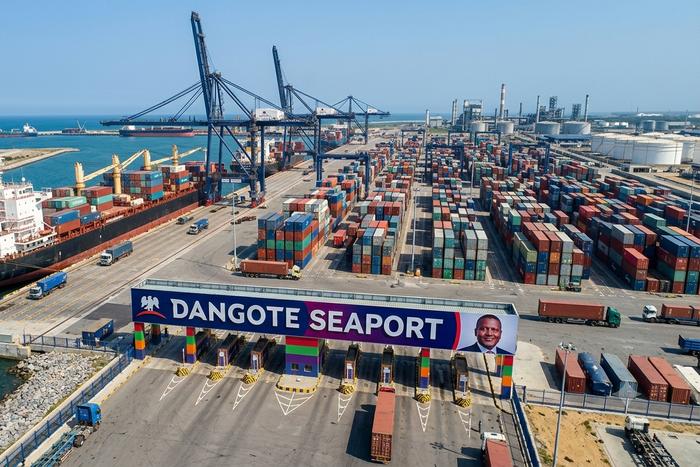
The group is looking towards China, the world’s largest shipbuilding nation, for the vessels needed to support that expansion. Chinese shipyards accounted for 54.6% of global shipbuilding output in 2024 and held nearly two thirds of the global orderbook at the start of 2025, giving Dangote access to an industrial ecosystem capable of producing vessels at considerable scale.
The growth in shipping demand is being driven by the sheer breadth of Dangote’s industrial operations. Cement, sugar, flour, fertiliser, petrochemicals and refined petroleum products all require substantial logistics networks, and the group’s expansion is increasing the amount of cargo moving between its facilities, African markets and international destinations. What was once a supporting function is increasingly becoming a strategic part of the business.
The refinery is central to that transformation. Dangote plans to invest $14.3 billion to double its current refining capacity from 700,000 barrels per day to 1.4 million barrels per day by 2029. That expansion is expected to increase the volume of refined products entering regional and international markets, placing greater demands on maritime logistics.
For Dangote, owning or securing greater access to vessels could provide more control over a critical part of the supply chain. Shipping costs, vessel availability and freight disruptions can all affect the economics of large commodity businesses. Building maritime capacity therefore gives the group another opportunity to reduce dependence on external logistics providers while creating greater certainty around the movement of its products.
There is also a wider African industrialisation story. Dangote’s expansion demonstrates the potential benefits of linking manufacturing capacity with transport infrastructure rather than treating logistics as a separate sector. A refinery that produces at world scale needs ships. A cement business serving multiple countries needs reliable freight. Fertiliser production requires distribution networks capable of reaching agricultural markets. As these operations expand together, the logistics ecosystem around them becomes increasingly valuable.
That strategy could become particularly important as Dangote looks beyond Nigeria. The group is already pursuing major investments across Africa, including plans for a $15 billion to $16 billion refinery in Kenya, although that project faces challenges around crude supply, infrastructure and financing.
The maritime push therefore fits into a much larger strategy: building an African industrial group capable of controlling more of the journey from raw material to finished product and ultimately to the customer.
If vessel movements do rise from 300 to 1,800 annually, Dangote will not simply be shipping more goods. It will be operating within a far more sophisticated logistics network of its own making. The significance is that one of Africa’s largest industrial groups is increasingly demonstrating that manufacturing scale, energy production and logistics scale can be built together. For an African continent still heavily dependent on external supply chains, that may be one of the most important lessons in Dangote’s expansion story.

Leave a Reply