



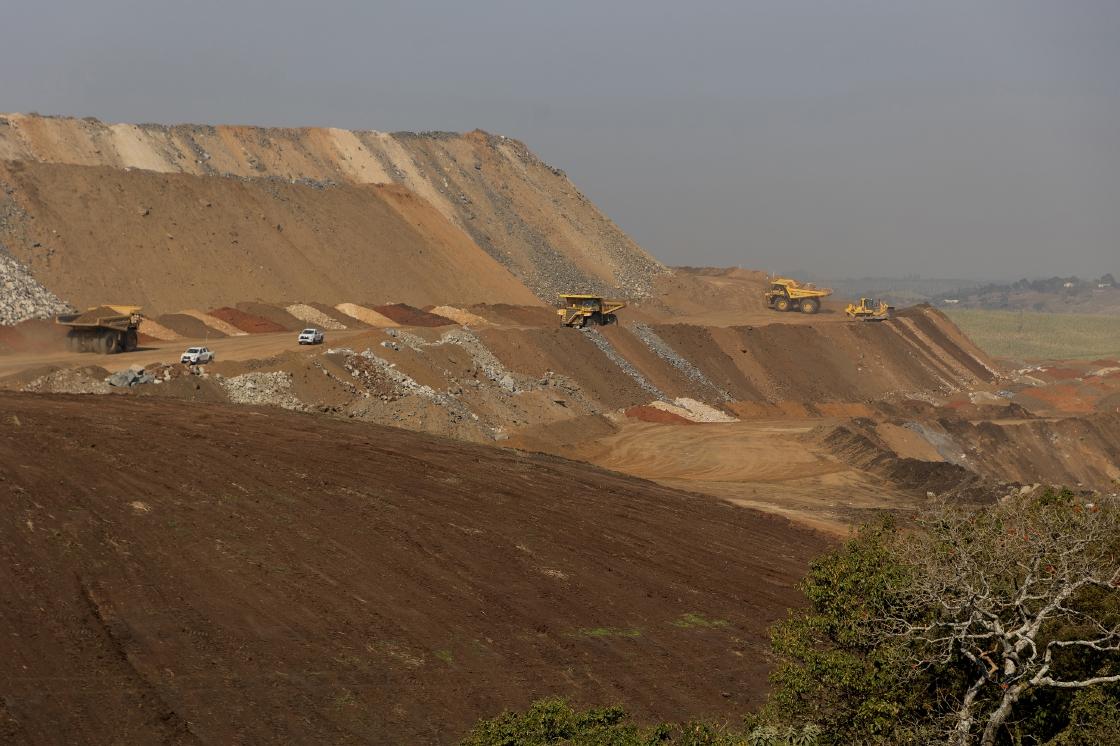
South Africa’s push to become a major player in the global lithium and critical minerals economy is running into a difficult question: how much productive land can be sacrificed in the pursuit of the minerals needed for the green energy transition?
On the country’s southeast coast, farmers and communities are increasingly challenging the expansion of lithium exploration and mining. Reuters reports that more than a dozen prospecting licences issued since 2023 cover approximately 73,000 hectares across 117 farms, alongside coastal areas. Farmers’ groups warn that the expansion could threaten around 30,000 jobs connected to farming, agricultural labour and services.
The dispute is particularly visible in KwaZulu Natal, where lithium mining is taking place alongside established sugar cane and macadamia farming. Some residents say blasting has damaged homes and vegetation, while farmers fear that mining could undermine the agricultural economy that supports communities and businesses in the region. South Africa’s Parliament has also undertaken oversight following community concerns relating to the SA Lithium operation at Magog.
SA Lithium disputes several of the allegations. Its director Ian Harbottle says the company has relocated 150 farmers voluntarily and argues that residents are significantly better off as a result. The company also says it has undertaken extensive anti pollution measures and created more than 1,000 jobs. On water, Harbottle maintains that mine water is retained in dams for processing and dust suppression rather than being discharged into rivers.
The controversy exposes a contradiction at the heart of the global energy transition. Lithium is essential to batteries used in electric vehicles and energy storage, yet extracting the mineral can itself transform landscapes and disrupt communities. At the same time, the environmental footprint of renewable energy remains considerably lower in some respects than fossil fuel-based power generation. A 2024 Breakthrough Institute analysis cited by Reuters estimated material extraction of about 1,180 tonnes per gigawatt for coal, compared with 59 tonnes for wind and 45 tonnes for solar, including battery storage.
For Africa, the lesson is particularly important. Countries across the continent are seeking to position their lithium, copper, cobalt, graphite and other critical minerals as strategic assets in the global transition to cleaner energy. South Africa itself has identified critical minerals as an important component of its economic revival and industrialisation ambitions. But mineral wealth does not automatically translate into sustainable development.
The South African debate therefore goes beyond whether lithium should be mined. It raises the more consequential question of how critical minerals should be developed. If mining destroys agricultural capacity, strains water resources or leaves communities feeling displaced from the economic benefits, the transition risks creating a new form of resource conflict. For governments and investors across Africa, the challenge will be to ensure that the green economy does not simply replace one extractive model with another but creates lasting value for the communities and economies supplying its raw materials.

Leave a Reply