



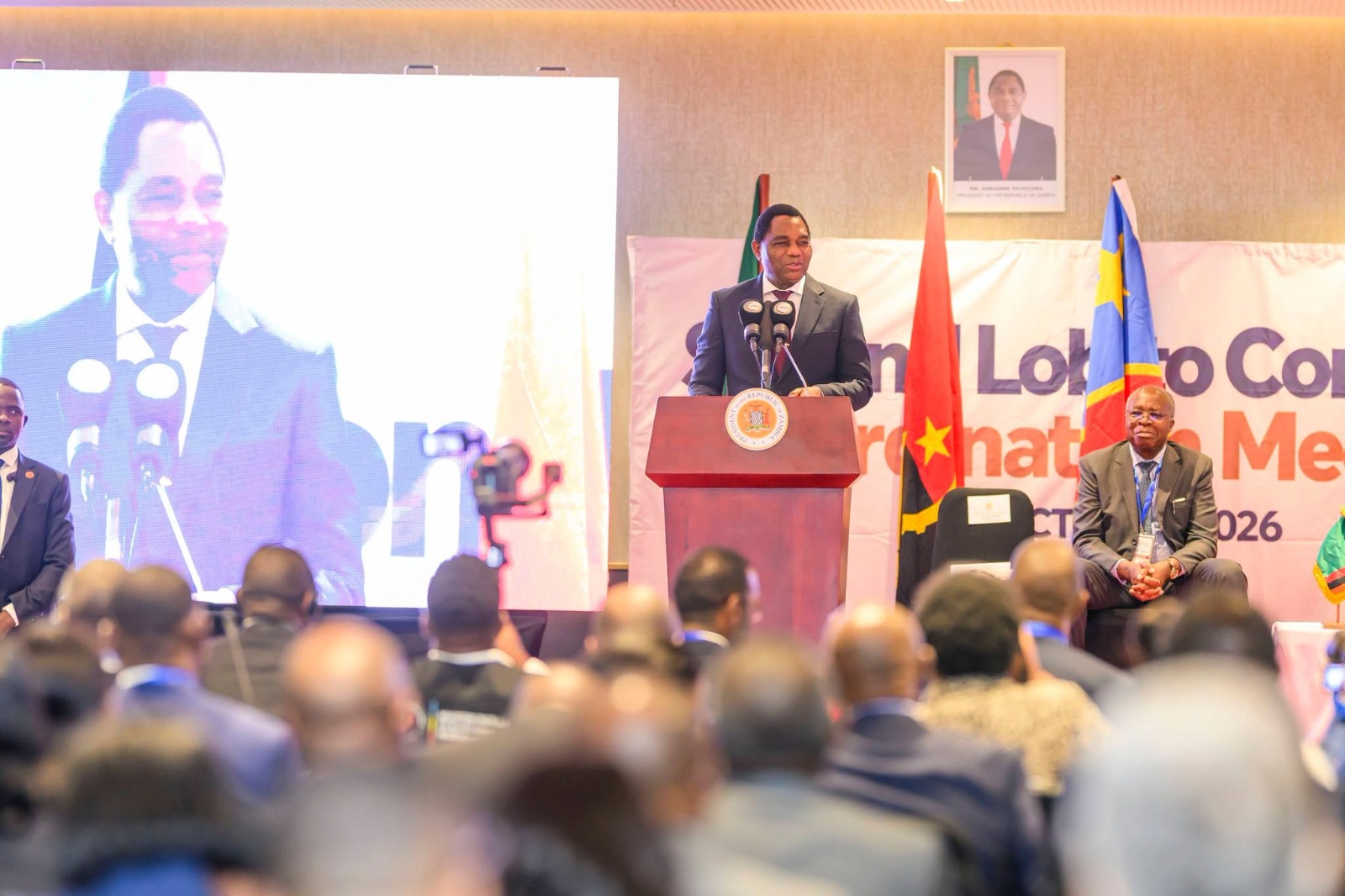
In a major push to unlock regional trade and position Southern Africa as a global commercial hub, President Hakainde Hichilema has officially opened the Second Lobito Corridor Coordination Meeting at the InterContinental Hotel in Lusaka.
“This corridor is integral to our Africa continental free trade area. Our ambition as a continent must not be concealed. We are the continent that does the least trade and investment with each other, with itself, and the Africa Continental Free Trade Area is one of those responses,” Hichilema said.
He emphasized that the Lobito Corridor serves as a foundational building block for the three participating countries. Furthermore, collaborating with technical and financial partners will advance the goals of the African Continental Free Trade Area (AfCFTA).
The Head of State reaffirmed Zambia’s commitment to ensuring this partnership yields tangible benefits for its citizens while advancing the Grow Zambia Agenda.
“Our shared goal is to turn commitments into investment, stronger regional trade and jobs by improving connectivity and lowering transport costs.”
The high-level two-day summit brings together senior government leaders, policy experts, and private sector stakeholders from Zambia, Angola, and the Democratic Republic of Congo (DRC), alongside international financial institutions, including delegation leads from the World Bank Group.
As global demand for African critical minerals accelerates, the joint opening in Lusaka underscores a unified commitment from Luanda, Kinshasa, and Lusaka to convert regional geographic proximity into sustained, cross-border industrial growth.
In partnership with the World Bank Group, the high-level regional summit marks a critical shift from policy alignment to operational execution for Southern Africa’s most ambitious trade route.
Speaking at the event, Finance and National Planning Minister Situmbeko Musokotwane stated that the platform goes beyond mere announcements to coordinate cross-border transit, facilitate investment discussions, and drive corrective decisions.
“We envisage an export-led economy, which of course makes the railway line to be relevant because we want to export things as competitively, cheaply, and quickly as possible. We also envisage drawing a lot of Foreign Direct Investment,” Dr. Musokotwane stated.
Meanwhile, World Bank Managing Director Anna Bjerde and regional delegations highlighted financial instruments, guarantees, and technical support for key corridor projects.
Speaking on the sidelines of the colorful event, Erik Fernstrom, World Bank Group Regional Practice Director for Infrastructure for Eastern and Southern Africa, highlighted that the corridor offers opportunities well beyond mining including agriculture, small businesses, refining, and industrialization.
“The World Bank will support the reforms and investments needed to make the corridor a driver of growth, job creation and wider economic activity,” Fernstrom said.
Leave a Reply