



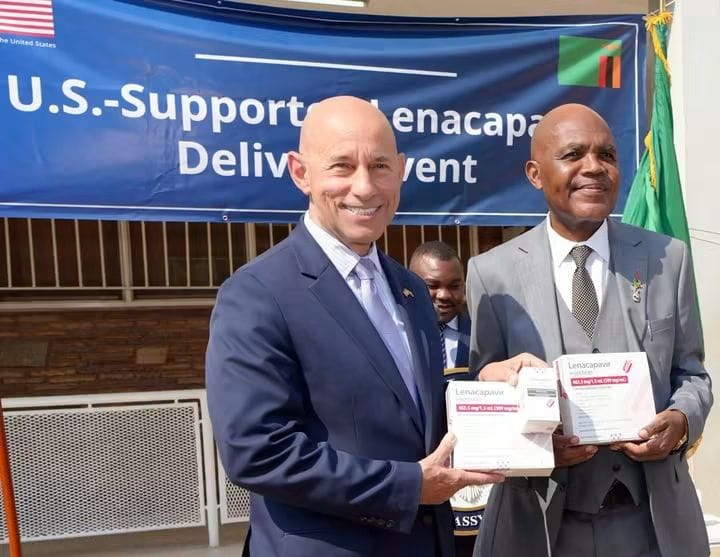
A groundbreaking American-made HIV prevention medication requiring just two injections per year has arrived in Zambia.
The medication offers a transformative new tool in the country’s fight against an epidemic that still claims 30,000 new infections annually.
On September 2, U.S. Assistant Secretary of State for African Affairs Frank Garcia joined Zambian Ministry of Health Permanent Secretary Dr. George Sinyangwe at the University Teaching Hospital in Lusaka to mark the arrival of the first U.S. government shipment of lenacapavir, developed by Gilead Sciences.
The medication, named Science magazine’s 2024 Breakthrough of the Year, has demonstrated near-perfect efficacy in clinical trials.
In the PURPOSE 1 trial involving over 5,300 adolescent girls and young women in sub-Saharan Africa, only two HIV infections occurred among more than 2,000 participants receiving lenacapavir – an incidence rate of just 0.07 per 100 person-years.
The US says the PURPOSE 2 trial showed a 96 percent reduction in HIV infections among gender-diverse individuals and cisgender men.
For pregnant and breastfeeding mothers, indicates rhe statement, the long-acting injectable offers a particularly powerful new option.
Oral PrEP continuation rates in Zambia have been challenging, with fewer than 15 percent of people who start daily pills still taking them six months later.
The twice-yearly injection eliminates the burden of daily adherence.
Despite significant progress – Zambia has achieved the 95-95-95 HIV treatment targets, with 98 percent of people living with HIV aware of their status, 98 percent on treatment, and 97 percent virally suppressed – prevention efforts are falling short.
“We are already off track,” said Dr. Chimika Phiri, National HIV Prevention Advisor, pointing to the national target of fewer than 15,000 new infections annually.
Zambia currently records approximately 29,000–30,000 new HIV infections each year.
Adolescent girls and young women account for 38 percent of new infections and are three times more likely to acquire HIV than their male peer.
The country has also seen 3,000 children aged 0–2 newly infected through mother-to-child transmission, with a transmission rate of 6 percent – above the global target of 5 percent.
Supply Constraints
However, the arrival of lenacapavir comes with a significant challenge: severe supply constraints.
Professor Lloyd Mulenga, director of infectious diseases at the Ministry of Health, confirmed that Zambia has received only approximately 13,000 doses – a fraction of the 60,000 to 80,000 expected through PEPFAR, plus additional shipments from the Global Fund and Unitaid.
The shortage has forced rationing, with authorities prioritizing re-injections for people already on the drug over new initiations and limiting the number of sites offering the service.
Despite the constraints, Zambia is moving forward with an innovative delivery strategy.
The Ministry of Health, in partnership with Unitaid, is deploying lenacapavir through a “hub and spoke” model that connects public health facilities to community-based sites – including drop-in centers, private pharmacies, and youth-friendly spaces – to reach populations the standard health system often misses.




Leave a Reply