



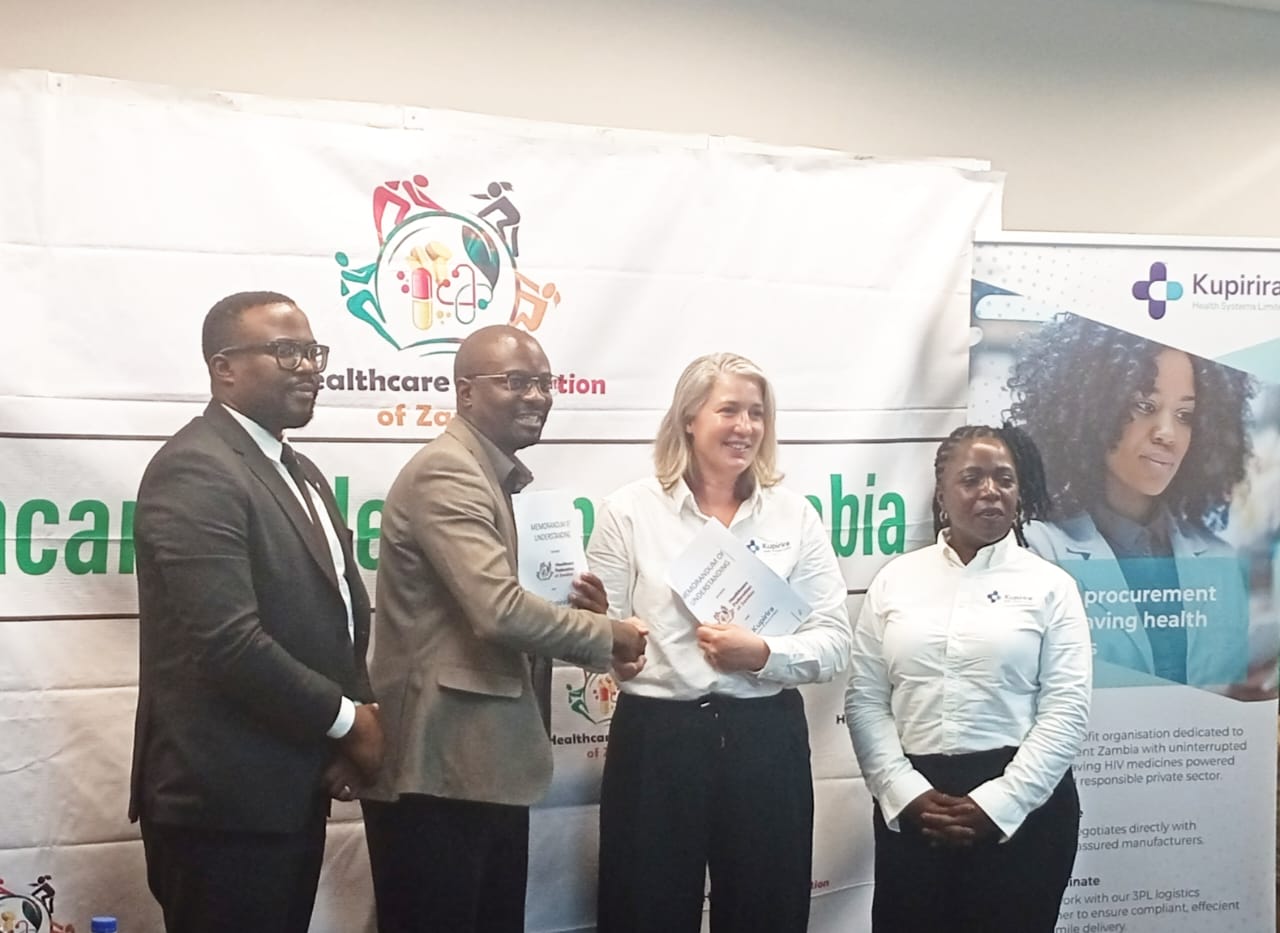
In an effort to respond to changes in the financing of HIV/ Health and growing donor fatigue, two key players: Kupirira Health Systems Limited (KHSL), the Healthcare Federation of Zambia (HFZ), have signed a Memorandum of Understanding (MoU) to re-engineer how HIV prevention and treatment logistics are sourced and delivered for the private sector across Zambia
Sealed in Lusaka on April 17, the agreement signals a decisive pivot toward a technology-driven, transparent, and efficient supply chain one designed to eliminate chronic stock-outs and safeguard decades of progress in HIV treatment.
“This is not a ceremonial document it’s a working tool,” HFZ Vice President Dr Kennedy Saini declared, capturing the urgency behind the initiative.
Closing the Gaps Left by Donors
For the private health sector, the writing is already on the wall: reliance on external funding is no longer sustainable.
Speaking at the signing, HFZ Vice President Dr Saini warned that inefficiencies continue to undermine critical programmes targeting HIV, tuberculosis, and malaria.
“We are not replacing the public sector we are reinforcing it,” Dr. Saini said. “This partnership is about building a resilient, responsive system that works for the people.”
He underscored HFZ’s role as a unifying platform for private hospitals, laboratories, and pharmacies while positioning Kupirira as the operational engine to drive procurement reforms.
A Homegrown Solution to a Global Funding Shift
At the heart of the initiative is Kupirira Health Systems Limited, a not-for-profit pooled procurement entity stepping in to ease pressure on public resources.
Managing Director and Co-founder Gertrude Musunka described the organisation as a product of deep industry experience, built to respond to shifting global health financing dynamics.
“The era of heavy donor dependence is changing. Local solutions are no longer optional they are necessary,” she said.
Kupirira’s model will aggregate demand for HIV medicines within the private sector, enabling cost efficiencies while freeing up government resources to continue serving the estimated 1.3 million Zambians dependent on public health supply systems.
“We are here to protect the gains made over the past two decades,” Musunka added. “And we are ready to act immediately.”
Government Backs Collaboration Drive
The initiative has also secured strong government backing through the Public Private Dialogue Forum (PPDF).
Delivering remarks on behalf of the forum, Policy Specialist Chimunya Chatupa on behalf of his Executive Director, framed the partnership as aligned with President Hakainde Hichilema’s broader health sector reforms, including the recent recruitment of 2,500 health workers.
“No institution can succeed in isolation,” Chatupa said. “Breaking silos is the only way forward. This partnership reflects real commitment not just intent.”
He stressed that while access challenges persist, collaborative models like this unlock new pathways to sustainable healthcare delivery.
From Agreement to Action
Unlike many policy declarations, the partners insist this deal moves quickly from paper to practice.
A joint working group is set to be launched within days, tasked with rolling out digital tracking systems, improving demand forecasting, and mobilizing diversified funding streams.
The ultimate goal is clear: a reliable, transparent supply chain where no Zambian is left without essential medicines.


Leave a Reply