



By Martin Musunka Jr
Zambia’s financial landscape is undergoing a structural shift as Stanbic Bank Zambia and Airtel Zambia officially roll out an integrated payment solution linking Airtel Money with point of sale (POS) terminals nationwide. The partnership arrives at a pivotal moment when Zambia’s financial inclusion rate has risen sharply to around 80.1 percent in 2025, driven largely by mobile money expansion and digital financial services adoption . Despite this progress, a significant portion of the population still remains outside formal banking structures, making mobile-enabled solutions critical for inclusive economic participation.
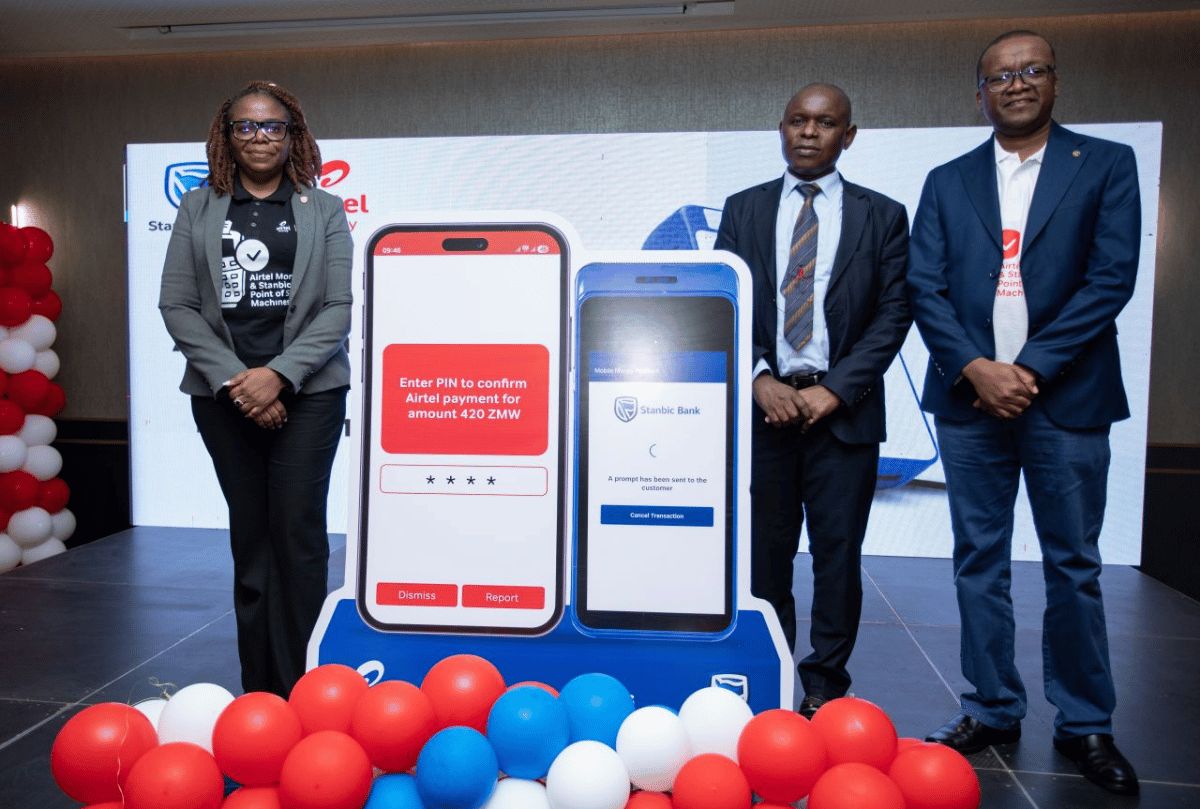
The innovation allows customers to complete transactions seamlessly at merchant outlets by selecting mobile money on a POS device, receiving a prompt on their mobile phone, and authorizing payment using a secure PIN. Once approved, funds are instantly transferred, with merchants receiving real-time credit into their Stanbic Bank accounts. Industry data shows that mobile money adoption in Africa continues to accelerate rapidly, with leading platforms processing billions of transactions annually and expanding financial access across underserved populations. In Zambia alone, mobile money usage has grown significantly over the past decade, contributing to a broader shift toward digital-first financial ecosystems.
In an interview with Solwezi Today, Stanbic Bank Head of Commercial Banking Chanda Mwila emphasized that the partnership aligns with Zambia’s broader financial inclusion strategy, stating that the goal is to ensure “every part of the country is able to participate in the financial system.” He further noted that combining banking infrastructure with mobile money reach strengthens economic visibility and supports policy development. Airtel Money Country Director Andrew Chuma, also speaking in an interview with Solwezi Today, highlighted that Stanbic Bank’s extensive POS footprint enables broader merchant access, adding that the collaboration removes the need for cash withdrawals and reduces transaction friction for customers nationwide.
Chuma further explained that the service is particularly impactful for SMEs, which have historically faced limitations due to card-only POS systems. By enabling mobile money payments, SMEs can now serve a wider customer base, improve cash flow efficiency, and reduce reliance on physical cash handling. This aligns with regional trends where mobile money ecosystems are increasingly powering SME growth and informal sector formalization across Africa.
Security remains a central pillar of the solution. Both institutions confirmed that no existing safeguards have been removed from either platform. Every transaction still requires mobile PIN authentication, ensuring that payments are authorized only by the account holder. This dual-layer security approach maintains trust while enabling faster, frictionless payments across the network.
The long-term impact of this collaboration is expected to be significant. As more informal businesses transition into digital payment systems, the formal economy is expected to expand, improving transaction visibility and supporting better monetary policy decisions. With Zambia’s mobile money ecosystem continuing to grow and financial inclusion surpassing the 80 percent mark, partnerships such as this are likely to play a defining role in shaping the country’s cashless future.




Leave a Reply